Part 4: The 1960s — A Government Top-up for the Home Deposit
In the 1960s, a government grant topped up eligible buyers’ savings, mortgage insurance opened another path to finance, and lending rules shaped who could buy a home. Part 4 of our ten-part Australian housing affordability history.

Part 4 of Rate Challenge’s ten-part history of Australian housing affordability, following the prices, home loans and government decisions that shaped the market from 1945 to 2025.

£750 in savings could become £1,000
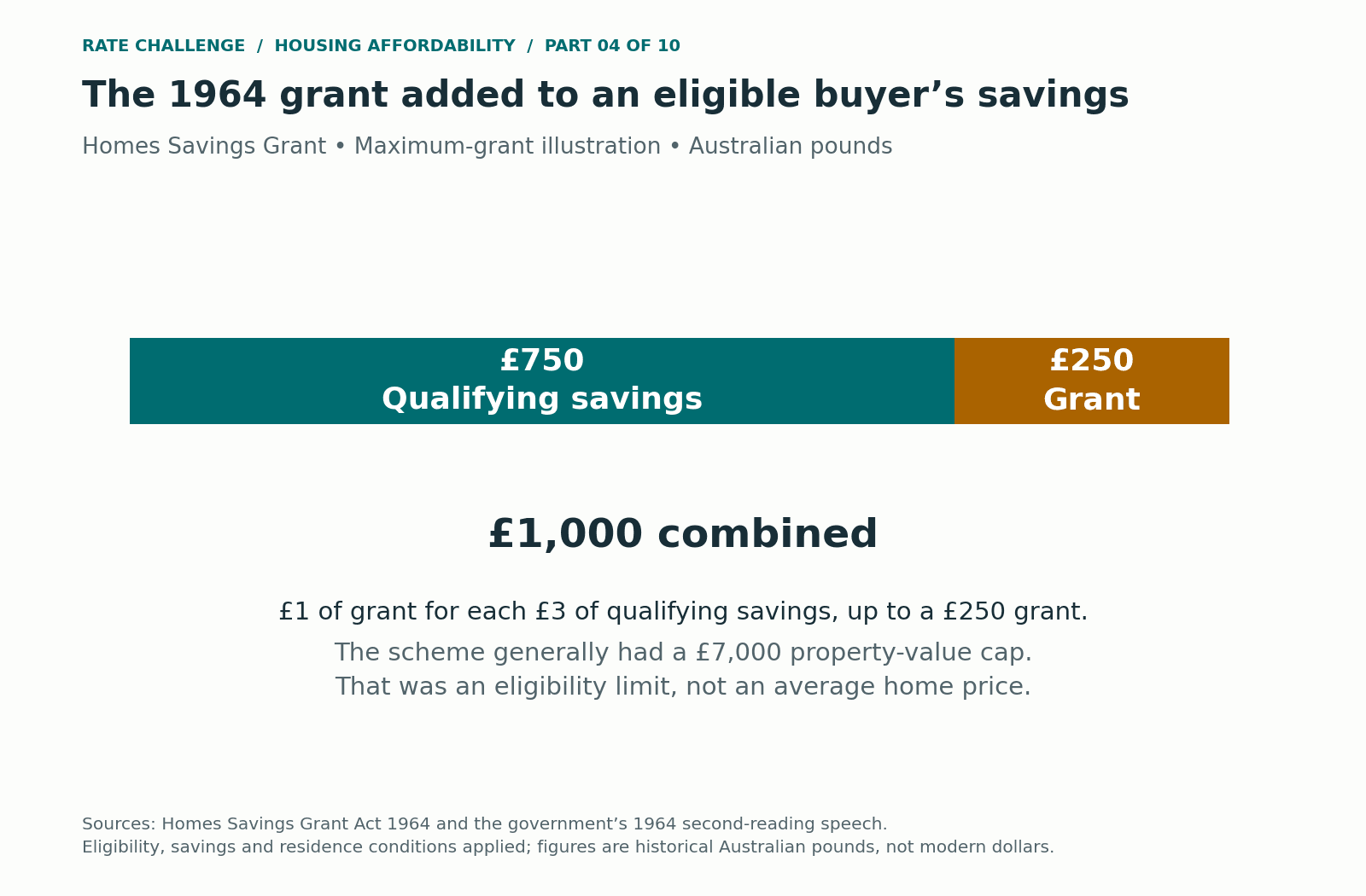
In 1964, Robert Menzies’ Coalition government offered eligible home buyers a direct addition to their savings: £1 for every £3 they had saved, up to a maximum grant of £250.
Under the Homes Savings Grant, £750 of qualifying savings could become £1,000 towards buying or building a home. These were Australian pounds, the currency in use when the scheme was introduced. 5
The government generally limited assistance to homes and land worth £7,000 or less. At that ceiling, the maximum grant covered about 3.6% of the property value. The ceiling was an eligibility rule, rather than an average house price. 5
 View larger chart ↗
The legislation received Royal Assent on 28 May 1964. It marked a more direct form of buyer assistance than the Commonwealth lending arrangements that had supported people building or buying their own homes during the 1950s. 25 4
For the buyer, the distinction was practical. The grant increased the money available to put towards a home, supplementing the household’s own savings. How far it went still depended on the purchase price, the buyer’s other funds and the finance they could obtain. 5
Who the scheme was designed to help
The original rules generally targeted married applicants under 36. Applicants needed to have saved in Australia for at least three years and satisfy residence requirements. The grant was intended for the couple’s home, with restrictions on either spouse having owned another home during their marriage. 25
This was a scheme built around young married savers. It offered an incentive to put money aside over time, but buyers also had to fit its rules. Two households facing a similar struggle to save could therefore have different access to help because of their age, marital status or savings history. 25
On a £7,000 purchase, £750 in savings and the maximum £250 grant would still leave £6,000 to fund, before purchase costs. That is an illustration using the scheme’s limits, rather than a record of what a typical buyer borrowed.
The government soon introduced a policy aimed at that remaining finance. The Housing Loans Insurance Act 1965 established the Housing Loans Insurance Corporation. 133
By insuring lenders against losses when borrowers defaulted, the corporation sought to help people obtain housing finance. The insurance covered the lender’s risk; borrowers still owed the loan and had to make the repayments. 134
The decade had begun with a credit squeeze
These measures followed a period when obtaining finance had become sharply more difficult.
During the 1960–61 credit squeeze, tighter lending and government measures helped slow the economy. The RBA’s historical account estimates that output, adjusted for inflation, fell about 3% from the September quarter of 1960 to the low point a year later. 124
For households considering a purchase, uncertainty about earnings arrived alongside tighter credit. The interest rate alone could not show how readily a loan was available.
The RBA’s advertised standard variable mortgage series averaged 5% in 1960, rising to about 5.9% in 1969. These rates were well below those that would later define the 1980s, but they existed within a more heavily controlled financial system. 9 125
From 1963, another gradual change created more room for housing lending. Savings banks had been required to hold a large proportion of their assets in government debt. The minimum was reduced from 70% to 40% between 1963 and 1978, allowing a greater share to go into housing loans. The transition extended well beyond the 1960s. 125
The policy changes tackled different stages of buying. The grant added to a buyer’s own funds, mortgage insurance dealt with part of the lender’s risk, and relaxed savings-bank rules created more room for housing loans. Together, they show how government policy could influence both the deposit and the finance needed to complete a purchase. 125
Changes to pay followed changes to finance
The Coalition remained in office throughout the decade, although its leadership changed. Menzies retired in 1966 and Harold Holt succeeded him. After Holt disappeared in December 1967, John McEwen served briefly before John Gorton became prime minister in January 1968. 24 119 120 121
During Gorton’s time in office, the Australian Conciliation and Arbitration Commission’s 1969 equal-pay decision secured equal pay for women doing the same work as men in qualifying circumstances. Its reach was limited: the broader principle of equal pay for work of equal value came in 1972. 28
Higher earnings could increase the amount a household had available for rent, savings and repayments.
What the 1960s changed
By the end of the 1960s, a would-be owner’s position depended on several connected questions: could they save enough, did they qualify for assistance, would a lender provide the balance, and could their earnings sustain the repayments?
The decade brought policies aimed at making that path more accessible, alongside an equal-pay decision with an initially limited reach. These developments help explain why affordability cannot be read from an interest-rate chart alone. Getting into a home required the savings, the finance and the household budget to work together.
Policy documents and historical rate records supplement our Housing Affordability Explorer, whose Australian comparison series begins in 1980.
Sources for this article
- [5] Commonwealth Minister for Housing, L. H. E. Bury; PM Transcripts: Homes Savings Grant Bill 1964, second-reading speech.
- [25] Federal Register of Legislation: Homes Savings Grant Act 1964 as made.
- [4] Western Australian legislation: Commonwealth and State Housing Agreement 1956.
- [133] Federal Register of Legislation: Housing Loans Insurance Act 1965.
- [134] Reserve Bank of Australia: Box C: Lenders Mortgage Insurance.
- [124] Reserve Bank of Australia; Glenn Stevens: Inflation and Disinflation in Australia: 1950–91.
- [9] Reserve Bank of Australia / source agencies: RBA Statistical Table F5: F5 INDICATOR LENDING RATES.
- [125] Reserve Bank of Australia; Guy Debelle: The State of the Mortgage Market.
- [24] National Museum of Australia: Robert Menzies: prime minister.
- [119] National Museum of Australia: Harold Holt: prime minister.
- [120] National Museum of Australia: John McEwen: prime minister.
- [121] National Museum of Australia: John Gorton: prime minister.
- [28] National Museum of Australia: Equal pay for women.