Part 2: A Housing Affordability History — 1945 to 1949
Part 2 of our housing affordability history explores the postwar shortage, the 1945 housing agreement and the race to build enough homes between 1945 and 1949.
Rate Challenge is an Australian mortgage broking business. Our ten-part history of housing affordability draws on official statistics, original legislation and government archives, with comparisons across Australia, the UK, US, Canada and New Zealand. For this chapter, we’ve examined the 1945 housing agreement and original postwar building records to trace how governments tried to turn a severe shortage into homes people could afford. 139
After a hard-fought and well-earned victory, Australians could finally look forward to peace and a better life at home. 147 148
A shortage years in the making
The housing task was substantial. In 1944, the Commonwealth Housing Commission estimated that the country was short of about 300,000 homes. 1
The Depression had interrupted construction. Then the war diverted workers and materials away from home building. By the time peace arrived, Australia had years of lost construction to make up. The shortage was already substantial before the postwar immigration programme began. 1
In 1945, Ben Chifley’s Labor government made a larger public housing system part of the answer. The Commonwealth–State Housing Agreement put federal finance behind state construction of rental homes, with working families on low and moderate incomes among those the system was intended to house. 1 2
Getting the homes built — and the rent within reach
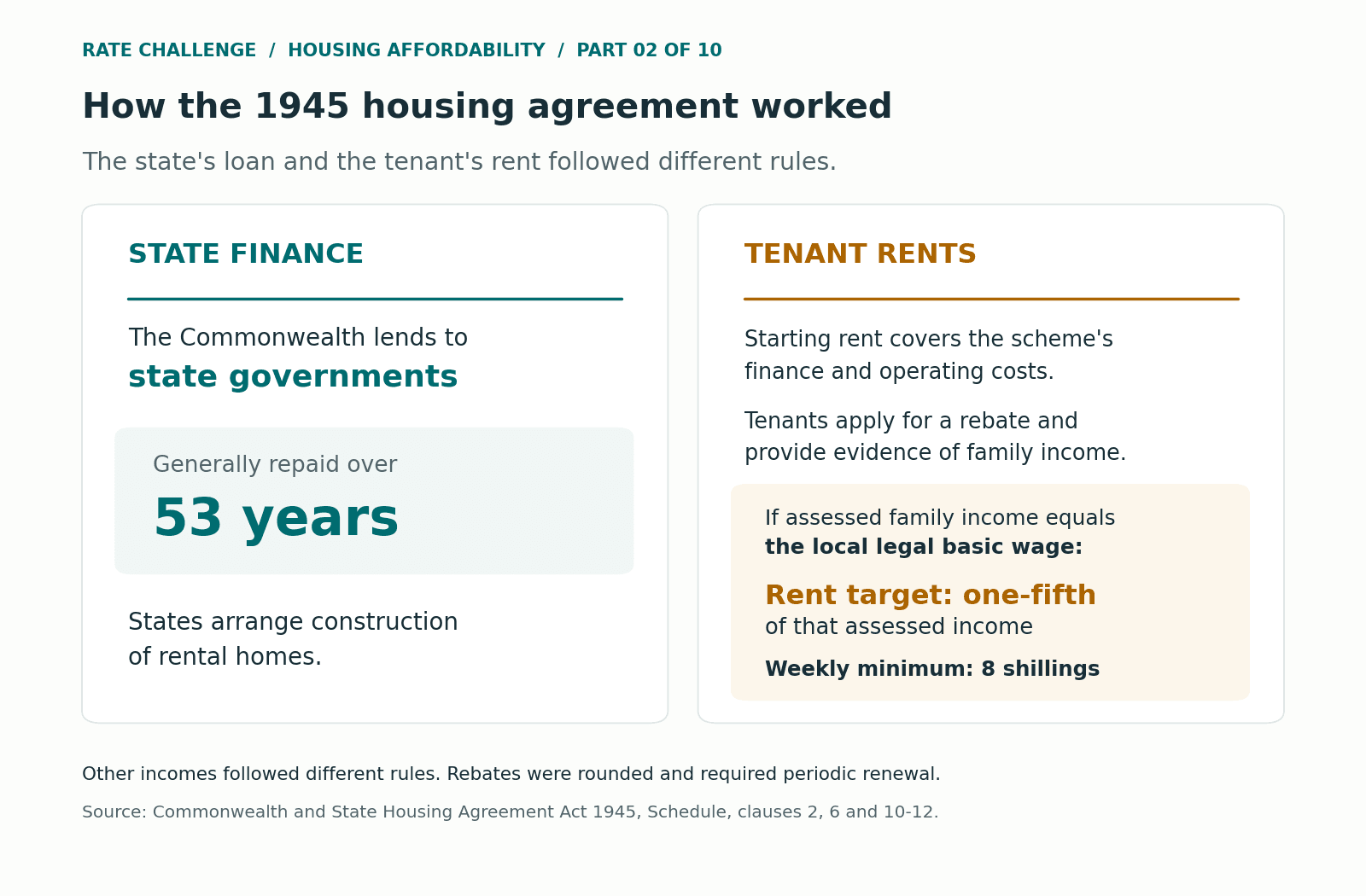
The agreement gave the Commonwealth and the states distinct jobs. The Commonwealth advanced the money, generally repayable by the states over 53 years. The states organised construction, while the Commonwealth also undertook to help them obtain labour and materials. 132
That long repayment period spread the states’ financing costs across decades. The homes would be available to rent, giving tenants a route into housing without first saving for a purchase.
The agreement also tackled the weekly rent. A property’s starting rent covered costs including finance, maintenance and rates. Tenants could then apply for a rebate, providing evidence of their family income. 132
When assessed family income matched the local legal basic wage, the rebate formula aimed to bring rent down to one-fifth of that income, subject to a minimum of eight shillings a week. Incomes above or below that wage followed different rules. 132
 View larger chart ↗
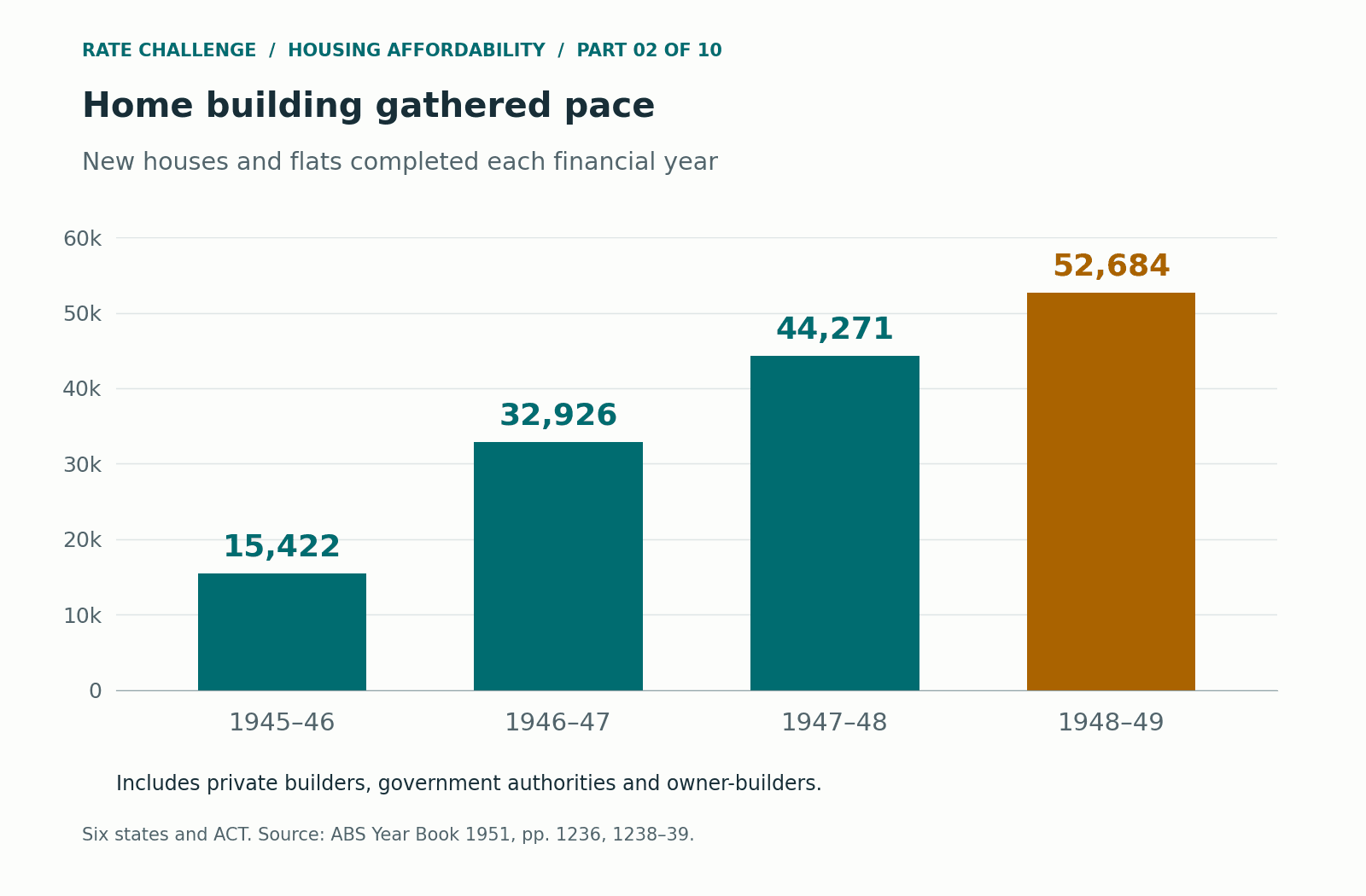
Home building gathers pace
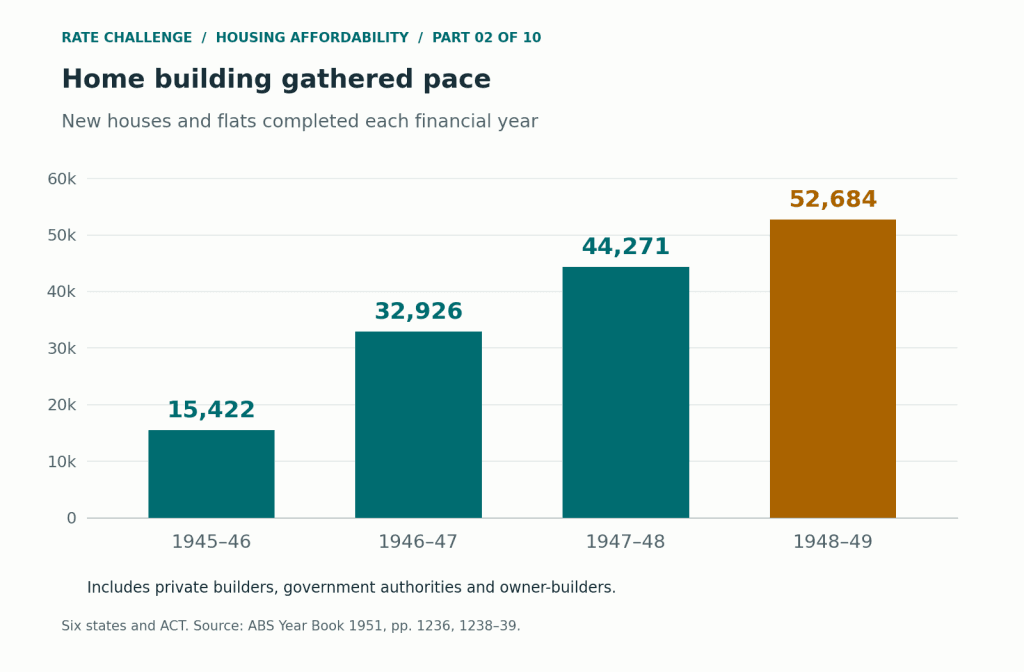
The building recovery soon showed up in the records. In 1945–46, the Commonwealth’s statisticians recorded 15,422 new houses and flats completed. By 1948–49, the annual total had reached 52,684 — more than three times as many in three years. These totals include private builders, government authorities and owner-builders. 140
 View larger chart ↗
Builders were also trying to keep up with a growing population. Arthur Calwell, appointed Australia’s first immigration minister in July 1945, led a programme intended to help develop and defend the country. Alongside assisted migration from Britain, Australia began accepting displaced people from Europe; the first group under that programme arrived in 1947. 22
New arrivals brought workers into an expanding economy and needed accommodation themselves. In New South Wales, early migrant-hostel accommodation often consisted of former army huts and other converted buildings, according to the National Archives. This separate programme provided a temporary place to stay while migrants settled in. 22 141
Construction was recovering quickly, but the task kept growing. The increase in completed homes tells us how much more builders were producing; it does not tell us how much of the shortage had been cleared.
Other countries, different routes into a home
Australia was one of several countries making housing a major postwar task. Some governments concentrated on public rental construction. Others helped buyers and builders obtain finance.
| Country | Postwar response | What it meant for housing |
|---|---|---|
| UK — England and Wales | The 1946 housing subsidy legislation supported new council homes. | Central and local government contributions helped cover building costs, allowing councils to charge lower rents than full costs would otherwise require. 142 143 |
| United States | Home-loan guarantees under the 1944 GI Bill were expanded in 1945. | Government backing helped eligible veterans borrow to buy, with larger guarantees and longer maximum loan terms. 144 |
| Canada | The Central Mortgage and Housing Corporation began operating in 1946. | Joint loans with approved lenders supported homes for purchase and rent. One scheme financed builders selling to veterans at prices set by CMHC. 106 145 |
| New Zealand | State rental construction resumed in 1944 and expanded after the war, continuing a programme begun in the 1930s. | More publicly owned homes offered secure tenancies, although rents still put them beyond the reach of many poorer households. 146 |
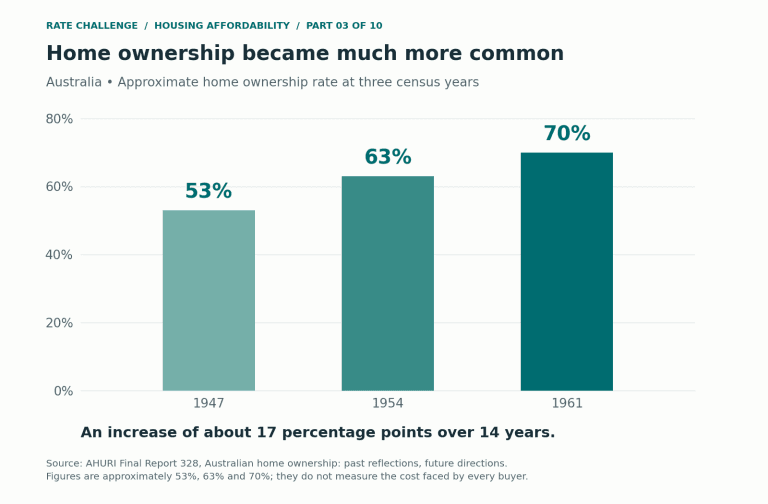
Australia’s agreement used public finance to add rental homes and offered rebates to eligible tenants. Alongside it, home ownership was already widespread: about 53 per cent of households owned or were buying their home in 1947, according to historical figures compiled by the Australian Housing and Urban Research Institute. 132 3
In December 1949, Robert Menzies returned as prime minister, leading the Liberal–Country Party Coalition. The next chapter follows the expansion of home ownership through the 1950s, as more Australians moved from finding somewhere to live to buying a place of their own. 24 3
Data note: The 1944 shortage is an estimate. Completion totals cover the six states and ACT and exclude some dwelling types. Rent provisions describe the scheme’s rules, not what every tenant paid.
Research and calculations: Rate Challenge.
Sources for this article
- [139] Rate Challenge: About Rate Challenge — mortgage broking and home-loan research.
- [147] Australian War Memorial: Victory in Europe (VE) Day. The defeat of Nazi Germany and Australian responses to the end of the European war; the Pacific war continued.
- [148] Australian War Memorial: Victory in the Pacific (VP) Day. The end of the Pacific war, celebrations and remembrance in August 1945. The opening’s reflection on pride and the hope of a better life is editorial interpretation of the wartime achievement and postwar housing response.
- [1] Australian Institute of Health and Welfare: Housing assistance in Australia 2024: Housing policy framework.
- [2] National Museum of Australia: Ben Chifley: prime minister.
- [132] Federal Register of Legislation: Commonwealth and State Housing Agreement Act 1945.
- [140] Commonwealth Bureau of Census and Statistics: Official Year Book of the Commonwealth of Australia, No. 38, 1951, Chapter XXVIII, §18, pp. 1236, 1238–39. Original chapter PDF. Rate Challenge calculated combined totals by adding completed houses and individual flats. Covers private contractors, government authorities and owner-builders in the six states and ACT. Excludes conversions, converted military huts, shop dwellings and some farm houses.
- [22] National Museum of Australia: Postwar immigration drive.
- [141] National Archives of Australia: Migrant hostels in New South Wales, 1946–78. The description of early accommodation relates to the separate migrant-hostel programme.
- [142] UK legislation: Housing (Financial and Miscellaneous Provisions) Act 1946, sections 1–2 and 26. This Act applies to England and Wales.
- [143] UK Parliament, House of Lords Hansard: Housing (Financial and Miscellaneous Provisions) Bill, 9 April 1946. Contemporary explanation of the rent and subsidy rationale; councils retained discretion over rents.
- [144] US Department of Veterans Affairs: History of the VA Home Loan Program, 1944–45 timeline.
- [106] Canada Mortgage and Housing Corporation: CMHC’s Story.
- [145] Central Mortgage and Housing Corporation: Housing in Canada: A Factual Summary, January 1947, printed pp. 12–13, describing joint lending and the Integrated Housing Plan operating in 1946.
- [146] Ben Schrader, Te Ara — the Encyclopedia of New Zealand: Housing and government: State loans and state houses. The state programme began before the war; construction resumed in 1944.
- [3] AHURI; Burke, Nygaard and Ralston: Australian home ownership: past reflections, future directions.
- [24] National Museum of Australia: Robert Menzies: prime minister.